Showing posts with label Free Projects. Show all posts

I.V.R.S SYSTEM FOR INDUSTRIAL CONTROL

|

I.V.R.S SYSTEM FOR INDUSTRIAL CONTROL

I.V.R.S SYSTEM FOR INDUSTRIAL CONTROL
INTERACTIVE VOICE RESPONSE SYSTEM INTERACTIVE VOICE RESPONSE SYSTEM 

Call IndianEngineers To Get this project kits,theory,presentstion and other Details 

Email   freshersblog@gmail.com

THE MENTIONED PROJECT IS BASED ON THE WORLD,S MOST POWERFUL  INTEL CONTROLLER 8051. MOST OF THE SERVICES PROVIDED IN TODAYS WORLD ARE VOICE INTERACTIVE, YOU CALL UP YOUR BANK AND COMPUTRISED VOICE WILL SPEAK TO YOU,AND GUIDE YOU TO ENTER A PARTICULAR NUMBER FROM YOUR PHONE TO GET THE DESIRED SERVICE.THIS SERVICE IS ONLY AVAILABLE THROUGH THE FAST SPEED COMPUTERS AND HAVING HUGE AMMOUNT OF MEMORY.WE EMPLEMENTED INTERACTIVE SERVICE FOR INDUSTRIAL APPLICATIONS  YOU CAN SWITCH ON/OFF DEVICES USING YOUR MOBILE PHONE OR LAND LINE PHONE EIGHT NUMBERS LOADS CAN BE CONNECTED TO THE EIGHT RELAY PROVIDED.NOT ONLY YOU CAN SWITCH ON /OFF DEVICES IT WILL ALSO DIAL OUT A TELEPHONE NUMBER IN CASE OF SECURITY THREAT,OR ANY SAFETY  OR  PROTECTION PARAMETERS  GOES BEYOND SAFETY LIMIT. IN CASE OF ANY OF THE ABOVE ,  FOR EX. TEMPERATURE OF THE MACHIONERY HAS GONE BEYOND SAFETY LIMIT ,THE DEVICE WILL FIRST SWITCH OFF THE PLANT AND DIALS OUT THE PRESTORED TELEPHONE NUMBER AND DELIVERS THE EMERGENCY MESSAGE. IT WILL DIAL OUT FOE FIVE TIMES AT THE INTERVAL OF ONE MINUTE AND AGAIN MONITOR THE PARAMETERS, AND IF THE PARAMETERS ARE NOT WITHEN LIMIT AGAIN IT WILL DIAL OUT . THIS CYCLE WILL REPEATE UNTIL THE PARAMETERS BECOMES NORMAL. 
APPLICATION: THIS PRJECT COULD BE USED FOR VARIETY OF PURPOSE WHERE YOU WANT TO CONTROL SOMETHING REMOTELY.
A)    SUPPOSE YOU OWN A COMPANY AND ARE THREE OR MORE PARTNERS AND ARE ALWAYS TRAVELLING. YOU HAVE AN OFFICE LOCATED SOME WHERE. AND HAVE A MAIN SERVER YOU DONOT WANT THAT SOMEBODY OTHER THEN YOUR PARTNER SHOULD HANDLE THIS SERVER DUE TO SECURITY REASON. AT THE SAME TIME YOU DONOT WANT TO KEEP YOUR SERVER ALL THE TIME ON SO THER THIS DEVICE COMES TO YOUR HELP ONLY REQUIREMENT FOR THIS DEVICE IS A PARALLEL TELEPHONE CONNECTION.AND OF COURSE POWER SUPPLAY.YOU CAN SWITCH ON YOUR SERVER REMOTELY FROM ANY WHERE IN THE WORLD. WHENYOU DIAL THE NUMBER WHERE THIS DEVICE IS CONNECTED WITH THE SERVER,AFTER EIGHT NUMBER OF BELL RINGING YOU WILL HEAR PLEASE ENTER YOUR PASSWORD. WHEN YOU ENTER THE PASSWORD. IF YOUR PASSWORD IS CORRECT THEN DEVICE WILL FURTHER RESPOND OTHERWISE WITHOUT GIVING ANY FURTHER RESPONSE DEVICE WILL DISCONNECT YOU.IF YOU NUMBER IS CORRECT YOU WILLRECEIVE THESE MESSAGE
PRESS ONE FOR NORMAL ON OFF, PRESS TWO FOR PASSWORD CHANGE PRESS THREE FOR TELEPHONE NUMBER CHANGE, PRESS STAR TO LISTEN THIS MENU AGAIN.
SO IF YOU PRESS 1 AND 1&1 YOU GET MESSAGE REQUESTED CHANNEL IS ON OR 1&0 REQUESTED CHANNEL IS OFF 1&2 TO NOW THE STATUS OF PREVIUSLY ON OR OFF CHANNELS SIMILARLY WITH ALL THE EIGHT CHANNELS SAME COMBINATIONS ARE APPLIES  YOU CAN PRESS STAR(*)  TO GO BACK TO PREVIOUS MENU.
NOW PRESSING TWO YOU CAN CHANGE THE PASSWORD AND DEVICE WILLRESPOND LIKE THIS PLEASE ENTER YOUR PASSWORD AND YOUR PASSWORD HAS BEEN CHANGED. SIMILARLAY BY PRESSING THREE YOU CAN CHANGE TELEPHONE NUMBRER.AND DEVICE WILL RESPOND PLEASE ENTER NEW TELEPHONE NUMBER &YOUR LELEPHONE NUBBER HAS BEEN CHANGED. 
B)     THIS WAS ONE EXAMPLE OF THIS DEVICE  SIMILARLY THIS COULD BE USED TO CONTROL OR SWITCH ON ANY PROCESS CONTROL MACHIONARY WHERE ALLFUNCTIONS ARE AUTOMATIC. ELECTRIC GRID COULD BE CONTROLLED REMOTELY. OR OUTOMATIC  PRODUCTION MACHIONERY COULD BE CONTROLLED EVEN DURING ODD HOURS WITH YIUR MOBILE PHONE.
SECURITY FEATURES OF THIS DEVICE SUPPOSE THERE IS FIRE AT THE MACHIONERY SPACE THIS DEVICE WILL SWITCH OFF THE MACHIONERY FIRST AND THE DIAL OUR THE PRE STORED NUMBER TO YOUR PHONE AND WILL DELIVER THE EMERGENCY MESSAGE. AND WILL KEEP DIALING UNTILL YOU COME AND PERSONALLY RESET THIS DEVICE.
THIS DEVICE HAS THE FOLLOWING BLOCKS
1.RING  DETECTOR CIRCUIT COMPRISES OF BRIDGE RECTIFIRE D1-D4 AND OPTO COUPLER U8 MCT2E
2. WATCH DOG TIMER COMPRISING OF IC 7400 AND U7 IC 4047
  1. DTMF DECODER IC U6 8870
  2. DIALER CIRCUIT RELAY RL2 TRANSISTER Q1
  3. OFF HOOK CIRCUIT RELAY RL1 AND TRANSFORMER TR1 C5 AND R8.
  4. MICROCONTROLLER CIRCUIT THE CENTRAL PROCESSOR 89C51
  5. SPEECH CIRCUIT IC UV1 1840 WHERE ALL THE MESSAGES ARE STORED
  6. AMPLIFIRE CIRCUIT IC UV2 LM 386
  7. SECURITY STORAGE IC 93C46
  8. AND LOAD CONTROLLER WHERE RELAY BOARDS WILL BE CONNECTED P1
  9. POWER SUPPLAY CIRCUIT IC U10 7805,BRIDGE RECTIFIRES D1-D4
  10. CAPACITOR C1 AND C2
  11. FIRE SENSOR IS CONNECTED TO CONNECTOR P2 CONNECTOR

AUTOMATIC INTELLIGENT TOLL -TAX

|

AUTOMATIC INTELLIGENT TOLL -TAX

AUTOMATIC   INTELLIGENT   TOLL -TAX
  
TOLL TAX PROJECTS TOLL TAX PROJECTS 
final year project automatic toll tax block diagram final year project automatic toll tax block diagram 
 WE BET OUR PRICE IS THE LOWEST IN THE MARKET CALL US NOW.  OR EMAIL FRESHERSBLOG@GMAIL.COM
OUR PROJECTS LOOK LIKE AS STUDENT HAS MADE THIS HIMSELF. 
CALL 09171408885 OR EMAIL   FRESHERSBLOG@GMAIL.COM 
THIS PROJECT IS DESIGNED TO MAKE UNATTENDED AUTOMATIC TOLL TAX STATIONS AT CHECK BARRIERS OR OCTRI CHCK POSTS 
Automatic toll tax project is designed ,using atmel 89c51 microcontroller &  descreate componants. Heart  of the project is an  ir transmitter and receiver modules ,these strong  powerfull  modules transmits  38khz  strong  ir beam, has a range of more than 15 feets are sufficiently enough for our project. I have designed this project as a simple emplementation of the toll collection process automatically in a model form. This should not be considered as a real toll collection system which require much more considerations , tests and huge amount of money, before they are actually put into use.

Email freshersblog@gmail.com to Get this project or its details Email freshersblog@gmail.com to Get this project or its details 
However  this project gives enough guidelines for  the actual dvelopment  of the toll collection system.  For the sake of simplicity , we have to make coin box exactly same as  used in pco coin box machine fixed on railway station or else whare. We have to make two coin size holes one for one rupee, and other for five rupee coin. You have to fixup coin sensors on these holes, one sensor should be fixed for five rupee coin and one sensor for one rupee coin.
OPERATION: when light vehicle is detected,  one rupee sensor led will glow also the device will speak out ” please enter one rupee” in three languages. if the coin is inserted, it will stop asking for the coin and gate will open. when the vehicle croses other side of the gate the gate will close. also the count value on the lcd will be updated . operation is similar for heavy vehicle where the device is going to ask for “five rupee coin” the project will maintain the complete details of all the vehicles crossing that way.. so no vehicle can cross without paying.

Terms & Conditions : Advance 100%.  
                                      Delivery  1 to 2 weeks.
Call Indianengineer’s at 09717408885 or email freshersblog@gmail.com or login
www.indianengineer.wordpress.com for the biggest list of projects

AUTOMATIC CONTROL OF UNMANNED RAIL GATE

|

AUTOMATIC CONTROL OF UNMANNED RAIL GATE

  AUTOMATIC   CONTROL OF UNMANNED RAIL GATE
  
automatic railway gate controll project automatic railway gate controll project 
 CONTACT US TO BOOK THIS PROJECT AT FRESHERSBLOG@GMAIL.COM
We  read news papers very often about the railway accidents happening at un attanded railway gates. Present project is designed to avoid such accidents if emplemented in spirit.    this project utilises two powerful  ir transmitter and two receivers ,one pair of transmitter and receiver is fixed at up side (from the train comes) at a level higher than human beeing in exact alignment and similarly other pair is fixed at down side of the train direction   sensor activation time is so adjusted by calculating the time taken at a certain speed to cross  at least one compartment of standard minimum size of the indian railway. I have considered 5 seconds for this project sensors are fixed at 1000 miters on both sides of the gate we call fore side sensor pair for commong towards gate train and aft sidesensors for the train just crosse the gate when foreside receiver get activated,  gate motor is turned on in one direction and gate is closed and stay closed till train crosses the gate and reaches aft side sensors  when aftside receiver get activated  motor turns in opposite direction and gate opens and motor stops . Buzzer will immidiately  sound at the fore side receiver activation and gate will close after 5 seconds so giving time to drivers to clear gate area in order to avoid trapping between gate. And stop sound after the train has crossed. Two other indications are provided for station master to know the status of gate   in case the gate is not closed due to any reason  a red signalling light fixed well before gate is enough to alarm the train driver to stop the train . The project is simple emplementation and subject to further improvement. Based on atmel 89c51 microcontroller.
 
Terms & Conditions : Advance 100%.  
                                      Delivery  1 to 2 weeks. 


 EMAIL FREHSERSBLOG@GMAIL.COM
www.indianengineer.in
WWW.INDIANENGINEER.WORDPRESS.COM
WWW.PROJECTSWORLD.WORDPRESSS.COM
WWW.INDIANENGINEER.TK
WWW.ENGINEERSPROJECT.BLOGSPOT.COM

CALL INDIANENGINEER TO GET ANY DETAILS ABOUT THIS PROJECT
WE ARE THE BEST PROJECT CONSULTANTS IN INDIA

PC TO PC LASER COMMUNICATION

|

PC TO PC LASER COMMUNICATION

FreeDo1
The above project uses two nos transreceiver modules ,and the circuit communicates at 9600 kbps. ‘c’ codes comes with along  with project
LASERPHOTO

PC TO PC FIBER OPTIC COMMUNICATION

|

PC TO PC FIBER OPTIC COMMUNICATION

PCTPCFIBERLASERPHOTOThe above project uses two nos transreceiver modules ,and the circuit communicates at 9600 kbps. ‘c’ codes comes with along  with project

100 Watt inverter circuit

|

100 Watt inverter circuit

100 Watt inverter circuit
Description
Here is a 100 Watt inverter circuit using minimum number of components.I think it is quite difficult to make a decent one like this with further less components.Here we use CD 4047 IC from Texas Instruments for generating the 100 Hz  pulses  and four 2N3055 transistors for driving the load.
The IC1 Cd4047 wired as an astable multivibrator produces two 180 degree out of phase 100 Hz pulse trains.These pulse trains are are preamplifes by the two TIP122 transistors.The out puts of the TIP 122 transistors are amplified by four 2N 3055 transistors (two transistors for each half cycle) to drive the inverter transformer.The 220V AC will be available at the secondary of the transformer.Nothing complex just the elementary inverter principle and the circuit works great for small loads like a few bulbs or fans.If you need just a low cost inverter in the region of 100 W,then this is the best.
Circuit Diagram with Parts List.
100-w-inverter-circuit www.projectsworld.wordpress.com 
Notes.
  • A 12 V car battery can be used as the 12V source.
  • Use the POT R1 to set the output frequency to50Hz.
  • For the transformer get a 9-0-9 V , 10A step down transformer.But here the 9-0-9 V winding will be the primary and 220V winding will be the secondary.
  • If you could not get a 10A rated transformer , don’t worry a 5A one will be just enough. But the allowed out put power will be reduced to 60W.
  • Use a 10 A fuse in series with the battery as shown in circuit.
  • Mount the IC on an IC holder.
  • Remember,this circuit is nothing when compared to advanced PWM inverters.This is a low cost circuit meant for low scale applications.
Design Tips.
The maximum allowed output power of an inverter depends on two factors.The maximum current rating of the transformer primary and the current rating of the driving transistors.
For example ,to get a 100 Watt output using 12 V car battery the primary current will be ~8A ,(100/12) because P=VxI.So the primary of transformer must be rated above 8A.
Also here ,each final driver transistors must be rated above 4A. Here two will be conducting parallel in each half cycle, so I=8/2 = 4A .
These are only rough calculations and enough for this circuit.

www.IndianEngineer.In

Email FreshersBlog@gmail.com
Biggest Project Service Provider in Delhi

All Types of Projects for all Branches are Available

150 Watt amplifier circuit

|

150 Watt amplifier circuit


Description
This is the cheapest 150 Watt amplifier circuit you can get,I think.Based on two Darlington power transistors TIP 142 and TIP 147 ,this circuit can deliver a blasting 150 W Rms to a 4 Ohm speaker.Enough for you to get rocked?,then try out this.
TIP 147 and 142 are complementary Darlington pair transistors which can handle 5 A current and 100V ,famous for their ruggedness. Here two BC 558 transistorsQ5 and Q6 are wired as pre amplifier and TIP 142 ,TIP 147 together with TIP42  (Q1,Q2,Q3)  for driving the transistors.This circuit is designed so rugged that this can be assembled even on a common board or even by pin to pin soldering.The circuit can be powered from a +/-45V 5A  dual power supply.You must try this circuit.Its working great.
Circuit Diagram & Parts List .
150-watt-amplifer-circuit.JPG
Notes.
  • Remember TIP 142 and 147 are Darlington pairs  .They are shown as conventional transistors in figure for ease.So don’t get confused.Even though each of them have 2 transistors ,2 resistors and 1 diode inside ,only three pins ,base emitter and collector are coming out.Rest are connected internally.So its quite OK to assume each of them as transistor for ease.
  • Use a well regulated and filtered power supply.
  • Connect a 10K POT in series with the input as volume control if you need.Not shown in circuit diagram.
TIP 142 & 147 Internal diagram and pin out.
tip-142-143-shematics-and-pinout.jpg

www.indianengineer.in

www.indianengineer.wordpress.com
email Us at

Freshersblog@gmail.com

Long Range FM Transmitter 1

|

Long Range FM Transmitter 1

Long Range FM Transmitter 1

How to make a long range FM transmitter at low cost

Description
The use of transmitters which have a more powerful output than the ‘flea-power’ are sometimes required when there are many obstacles in the path of the surveillance transmitter and monitoring station receiver, or the distance between them is too far so as to make a low powered device feasible. Whereas a typical microtransmitter will produce an RF power in the order of just a few milliwatts, i.e. a few thousandths of a watt, the VHF-FM transmitter described has a power output of between around a half and 2 watts, depending on the power source, which may be anywhere between 6 volts and 30 volts d.c. The battery or batteries should be of the alkaline high power type, since the current drain will be found to be relatively higher when compared to microtransmitter current drain. The power output of this device is somewhat proportional to the current drain and so therefore both may be decreased by altering the value of R6 to a higher resistance, or a variable resistor with a value of around 1k may be introduced in series with the existing R6, so as to give a variable power output. The variable resistor must not be a wirewound device because this would act as an inductor which will cause feedback problems.The audio input to the power oscillator, which incidentally is formed by TR2 and associated components, is derived from a piezoelectric microphone which drives the simple audio frequency amplifier TR1. The input of the audio amplifier is controlled by the gain pot R1, which selects the correct amount of voltage that is generated by the piezoelectric microphone, then connects this signal to the base of audio amplifier TR1 via C7. It may be found that there is insufficient housing space for a bulky piezoelectric microphone, so with a slight modification to the circuit, it is possible to employ an electret microphone insert as shown. Since the RF field that is generated by this transmitter is relatively large, the problem of RF feedback may very well be encountered. This may be overcome by placing the transmitter inside a metal enclosure, keeping all internal wiring as short as possible and the aerial wire.

Component listing for 1 watt transmitter

Resistors Semiconductors R1 = 27k TR1 = BC547 R2 = 330k TR2 = 2N2219 fitted with heatsink R3 = 5k6 MIC = piezoelectric microphone R4, 5 = 10k R6 = 100R
L = 6 turns 22 gauge enamelled wire wound on 3⁄16″ former
Capacitors
C1, 2, 3, 8 = 330 pF C4 = 2–10 pF trimmer C5 = 4p7 C6 = 1 nF
C7,C8 = 40uF/25V Electrolytic

Circuit diagram for Long range FM Transmitter

indianengineer indianengineer 

www.indianengineer.in

www.indianengineer.wordpress.com
email Us at

Freshersblog@gmail.com

Infrared motion detector circuit

|

Infrared motion detector circuit

Infrared motion detector circuit
Description.
Here is the circuit diagram of an infrared motion detector that can be used to sense intrusions.Infra red rays reflected from a static object will be in one phase, and the rays reflected from a moving object will  be in another phase.The circuit uses this principle to sense the motion.
The IC1 (NE 555)  is wired as an astable multivibrator .The IR diode connected at the output of this IC produces infrared beams of frequency 5Khz.These beams are picked by the photo transistor Q1 .At normal condition ie; when there is no intrusion the output pin (7) of IC2 will be low.When there is an intrusion the phase of the reflected waveforms has a difference in phase and this phase difference will be picked by the IC2.Now the pin 7 of the IC 2 goes high to indicate the intrusion.An LED or a buzzer can be connected at the output of the IC to indicate the intrusion.
Circuit diagram with Parts list.
ir-motion-detector-circuit
Notes.
  • Comparators IC2a and IC2b are belonging to the same IC2  (LM1458).So the power supply is shown connected only once.No problem.
  • When there is disturbance in the air or vehicles passing nearby,the circuit may get false triggered.
  • POT R5 can be used for sensitivity adjustment.

www.indianengineer.in

www.indianengineer.wordpress.com
email Us at

Freshersblog@gmail.com

Lead acid battery charger circuit

|

Lead acid battery charger circuit

Lead acid battery charger circuit
Description
Here is a lead acid battery charger circuit using IC LM 317.The IC here provides the correct charging voltage for the battery.A battery must be charged with 1/10 its Ah value.This charging circuit is designed based on this fact.The charging curent for the battery is controlled by Q1 ,R1,R4 and R5. Potentiometer R5 can be used to set the charging current.As the battery gets charged the the current through R1 increases .This changes the conduction of Q1.Since collector of Q1 is connected to adjust pin of IC LM 317 the voltage at the output of of LM 317 increases.When battery is fully charged charger circuit reduces the charging current and this mode is called trickle charging mode.
Circuit Diagram with Parts List.
battery-charger.jpg
Notes .
  • Connect a battery to the circuit in series with a ammeter.Now adjust R5 to get the required charging current. Charging current = (1/10)*Ah value of battery.
  • Input to the IC must be minimum 15V to get 12 V for charging the battery .Take a look at the data sheet of LM 317 for better understanding.
  • Fix LM317 with a heat sink.

www.indianengineer.in

www.indianengineer.wordpress.com
email Us at

Freshersblog@gmail.com

Fire alarm circuit

|

Fire alarm circuit

Fire alarm circuit
Description.
Here is a simple fire alarm circuit based on a LDR and lamp pair for sensing the fire.The alarm works by sensing the smoke produced during fire.The circuit produces an audible alarm when the fire breaks out with smoke.
When there is no smoke the light from the bulb will be directly falling on the LDR.The LDR resistance will be low  and so the voltage across it (below .6V).The transistor will be OFF and nothing happens.When there is sufficient smoke to mask the light from falling on LDR, the LDR resistance increases and so do the voltage across it.Now the transistor will switch to ON.This gives power to the IC1 and it outputs 5V.This powers the tone generator IC UM66 (IC2)  to play a music.This music will be amplified by IC3 (TDA 2002) to drive the speaker.
The diode D1 and D2 in combination drops 1.4 V to give the rated voltage (3.5V ) to UM66 .UM 66 cannot withstand more than 4V.
Circuit diagram with Parts list.fire-alarm-circuit

Notes. 
  • The speaker can be a 8Ω tweeter.
  •  POT R4 can be used to adjust the sensitivity of the alarm.
  • POT R3 can be used for varying the volume of the alarm.
  • Any general purpose NPN transistor(like BC548,BC148,2N222) can be used for Q1.
  • The circuit can be powered from a 9V battery or a 9V DC power supply.
  • Instead of bulb you can use a bright LED with a 1K resistor series to it.

www.indianengineer.in

www.indianengineer.wordpress.com
email Us at

Freshersblog@gmail.com

VHDL EDGE DETECTION SYNOPSIS

|

VHDL EDGE DETECTION SYNOPSIS


INTRODUCTION


VHDL was developed to provide a standardized and technology independent way to describe formally the behavior and structure of digital electronic systems. It offers the technical means to provide functional, timing, and other specifications for digital electronic systems in a form that will be useful long after the original system is delivered. Technology independence permits the separation of the behavior function (plus timing) from its implementation, which makes incorporating new technologies easier.
The main goal of image processing is to create systems that can scan objects and make judgments on objects at rates many times faster than that of a skilled human observer. Naturally, the first step in building such systems is to identify the imaging functions that allow a computer-based system to behave like a trained human operator. With this achieved the emphasis can then be placed on making that system run faster, and in order to do this you need to find the biggest performance bottleneck in the system and remove it.


WORKING PRINCIPLE

Edges are considered to be most important image attributes that provide
valuable information for human image perception. With the advent of
artificial intelligence systems and forensic science the process of edge
detection has achieved the most sought status. Edge detection is a very
complex process affected by deterioration due to different level of noise.
A number of operators are defined to solve the problem of edge detection
[1–6]. They behave well in one application but poorly in other.


Before an image can be segmented, the objects in that image must be detected and roughly classified as to shape and boundary characteristics (edges).
Edges are significant local changes in the image and are important features for analyzing images. Edge detection is frequently the first step in recovering information from images. Many dge detectors, such as Roberts Operator, Sobel operator, Prewitt Operator, Laplacian Operator, etc., have been developed in the last two decades. Since the Sobel operator is one of the most commonly used edge detectors in image processing systems, we used this operator to illustrate our design methodology.


Consider the arrangement of pixels about the pixel [i, j] shown in Figure 2.7 [5]. The Sobel operator is the magnitude (M) of the gradient computed by


EH , EV , EDL and EDR are the absolute values of EH , EV , EDL , EDR , respectively. E^ is the absolute value in the direction perpendicular to the direction of the maximum absolute value. EH , EV , EDL and EDR are called the differences in intensity along the horizontal, vertical, and left and right diagonal direction, respectively. They can be calculated individually by convoluting the image with four 3 x 3 windows (i.e., the Sobel operators) as shown in Figure


This procedure is also called filtering.The magnitude (M) is then compared to a particular threshold to determine the edge pixels. A pixel is declared to be an edge pixel if and only if M is greater than or equal to the threshold.


Example of Horizontal Filter


Direction Assignment


Figure  shows a convolution table containing the pixel located at coordinate [i; j] and its eight neighbors. As shown in Figure 2, the table is moved across the image, pixel by pixel. For a 256£256 pixel image, the convolution table will move through 64516 (254£254) different locations. The algorithm in Figure 4 shows how to move the 3£3 convolution table over a 256£256 image. The lower and upper bounds of the loops for i and j are 1 and 254, rather than 0 and 255, because we cannot calculate the derivative for pixels on the perimeter of the image.

The Sobel edge detection algorithm identifies both the presence of an edge and the direction of the edge (Figure 6). There are eight possible directions: north, northeast, east, southeast, south, southwest, west, and northwest.

For each direction, Figure shows an image sample, a convolution table, and the encoding of the direction. In the image sample, the edge is drawn in white and direction is shown with a black arrow. Notice that the direction is perpindicular to the edge. The trick to remember the edge direction is that the direction points to the brighter side of the edge. The eight directions are grouped into four orientations: NE SW, N S, E W, and NW SE.

For a convolution table, calculating the presence and direction of an edge and is done in three major steps:

1. Calculate the derivative along each of the four orientations. The equations for the derivatives are written in terms of elements of a 3£3 table

Deriv NE SW = (table[0;1]+2£table[0;2]+table[1;2]) ¡ (table[1;0]+2£table[2;0]+table[2;1])
Deriv N S = (table[0;0]+2£table[0;1]+table[0;2]) ¡ (table[2;0]+2£table[2;1]+table[2;2])
Deriv E W = (table[0;2]+2£table[1;2]+table[2;2]) ¡ (table[0;0]+2£table[1;0]+table[2;0])
Deriv NW SE = (table[1;0]+2£table[0;0]+table[0;1]) ¡ (table[2;1]+2£table[2;2]+table[1;2])


2. Find the value and direction of the maximum derivative, and the absolute value of the derivative that is perpindicular to the maximum derivative.
EdgeMax = Maximum of absolute values of four derivatives
DirMax = Direction of EdgeMax
EdgePerp = Absolute value of derivative of direction perpindicular to DirMax


3. Check if the maximum derivative is above the threshold. When comparing the maximum derivative to the threshold, the Sobel algorithm takes into account both the maximum derivative and the derivative in the perpindicular direction.
if EdgeMax + EdgePerp/8 >= 80 then
Edge = true
Dir = DirMax
else
Edge = false
Dir = 000


Row Count of Incoming Pixels

The output signal o row shall show the row number (between 0 and 255) for the most recent pixel that was received from the PC. The signal o row shall be initialized to 0. When the last pixel of the image is sent to the FPGA, o row shall be 255. The seven-segment controller in top sobel architecture displays the value of o row on the seven segment display of the FPGA board.


Memory

256£256 bytes (=65536 pixels) will be sent to the Sobel circuit byte by byte either by a testbench (for functional and timing simulation) or by PC to the FPGA (for real test on FPGA board) through the serial port. As illustrated below, you can do Sobel edge detection by storing only a few rows of the image at a time.
To begin the edge detection operations on a 3£3 convolution table, you can start the operations as soon as the element at 3rd row and 3rd column is ready. Starting from this point, you can calculate the operations for every new incoming byte (and hence for new 3£3 table), and generate the output for edge and direction.
Some implementation details are given below, where we show a 3£256 array. Other memory configurations are also possible.

1. Read data from input (i pixel) when new data is available (i.e. if i valid = ’1’)

2. Write the new data into the appropriate location as shown below. The first byte of input data (after reset) shall be written into row 1 column 1. The next input data shall be written into row 1 column 2, and so on. Proceed to the first column of the next row when the present row of memory is full.
256 bytes
a1 a2 a3 a4 a5 a6 a7 a8 a9 a10 a11 a12 a13 ::: a255 a256
3 rows b1 xx xx xx xx xx xx xx xx xx xx xx xx … xx xx
xx xx xx xx xx xx xx xx xx xx xx xx xx … xx xx


3. The following shows a snapshot of the memory when row 3 column 3 is ready.
Row Idx
1st a1 a2 a3 a4 a5 a6 a7 a8 a9 a10 a11 a12 a13 ::: a255 a256
2nd b1 b2 b3 b4 b5 b6 b7 b8 b9 b10 b11 b12 b13 ::: b255 b256
3rd c1 c2 c3 xx xx xx xx xx xx xx xx xx xx …. xx xx


4. At this point, perform the operations on the convolution table below:
a1 a2 a3
b1 b2 b3
c1 c2 c3
Note: This requires 2 or 3 memory reads to retrieve the values from the memory
(depending on how you design your state machine). Come up with a good design so
that the above write and read can be done in parallel.
5. When the next pixel (c4) arrives, you will perform the operation on the next 3£3 convolution table:
a2 a3 a4
b2 b3 b4
c2 c3 c4

6. When row 3 is full, the next available data shall be overwritten into row 1 column 1. Although physically this is row 1 column 1, virtually it is row 4 column 1. Note that the operations will not proceed until the 3rd element of 4th row (d3) is available in which case the operation will be performed on the following table based on the virtual row index as depicted in the following figure.
Virtual
Row Idx
4th d1 d2 d3 a4 a5 a6 a7 a8 a9 a10 a11 a12 a13 ::: a255 a256
2nd b1 b2 b3 b4 b5 b6 b7 b8 b9 b10 b11 b12 b13 ::: b255 b256
3rd c1 c2 c3 c4 c5 c6 c7 c8 c9 c10 c11 c12 c13 ::: c255 c256
the convolution table:
b1 b2 b3
c1 c2 c3
d1 d2 d3

7. Moving the 3£3 table over the 256£256 memory and performing the operation is in fact a convolution process. Regarding that the operations will start at the 3rd row of 256£256 memory and at the 3rd element of each row, the number of 3£3 tables on which the operations will be performed, is calculated by: 254£ 254 = 64516.
Your memory arrays shall be formed using instances of the 1£256 entry memory (provided in Ram.vhd), where each entry is 8 bits wide.

Note: The inputs to the memory are registered and the outputs from the memory are unregistered.
The figures below show the behaviour of memory for a write operation, a read
operation, and a write followed by two reads.

SPECIFICATION


The Sobel edge detection system detects edges in images using the Sobel operator. The image pixels will be supplied in raster scan order (i.e. rows are scanned left to right and top to bottom.) The edge detector will serially output data which contains edge information. The system should be synchronized by a system clock. The system should be designed in such a way that images of various size can be processed.


OBJECTIVES


The objective of our Sobel edge detection system is to perform the process of edge
detection, including storing a portion of the input image, filtering, comparing and determining the edge pixels.
Frequently, the gray level of a pixel is assigned a value in the range 0 to 255, with 0 corresponding to black, 255 corresponding to white, and shades of gray distributed over the middle values [6]. This value can be represented by an 8-bit vector. Since the filter outputs are  calculated by Equations (2), (3), (5) and (6), we need 2 more bits to represent the partial summation magnitude, and one more bit to represent the sign bit of the subtraction. As a result, we need 11 bits to represent the filtering output. In order to use a standard bus, 12-bit vectors are used to represent the four filtering outputs. After edge detection, each edge pixel is assigned to the foreground value (255), while non-edge pixels are assigned to the background value (0). In the previous example, M is equal to 68. If the THRESHOLD is less than 68, then the center pixel in the window is declared to be part of an edge and its value is set to be the foreground value (255). Otherwise, the center pixel is not declared to be an edge pixel and the background value (0) is assigned to it.


SYSTEM LEVEL DECOMPOSITION OF SOBEL EDGE DETECTOR


BLOCK DIAGRAM

Block diagram of the Sobel edge detection system


Decomposition of the Sobel edge detection system


FUTURE SCOPE


1. Develop an interface for automatically capturing and changing the generics

In this project, we explained the generics and their usage. We discussed that there are two
places in the VHDL codes where the actual values of the generics are given the architecture body or the configuration body. Defining the generics in the configuration body allows design reuse. It is a better solution.
The VHDL models can be developed automatically by the SGE tool. When developing a design entity using the SGE tool, the generics can be declared and assigned value by using SGE Symbol Attribute tool.


2. A hardware architecture of the Sobel algorithm for edge detection is proposed in this paper. The technology of realizing the edge detector for obtaining the movement parameters of lateral vehicle in VCAS by FPGA provides a real time technique, which replaces programming on the microprocessor and releases the computation load of microprocessor. This approach is efficient and reliable, can be easily realized via SoC or ASIC as a special structure of the economical embedded system instead of high performance microprocessor.


CONCLUSION

We have verify and synthesise the module of image processing using VHDL and also verify and synthesise the function of Horizontal Filter, Vertical Filter, Diagonal Left Filter And Diagonal Right Filter.


1

CLICK HERE TO SEE MORE ABT THIS PROJECTS SYNOPSIS
bY :- SAURABH CHITRANSI

WIRELESS MESSAGING VIA MOBILE/LANDLINE

|

WIRELESS MESSAGING VIA MOBILE/LANDLINE

Project Descreption
The main objective of this system is to transmit message or text through ordinary Land Line Telephone/mobile from one end (source) to another end (designation). This is get achieved by the DTMF technology. It has two sections one for editing the text and to transmit the edited text and the other section consist for receiving the text message. The system works on the DTMF technology. (Dual Tone Multiple Frequency).
It involves several steps. They are
DTMF decoding/Encoding process
Ring sensing
ON/OFF hook detection
Displaying the message in LCD
The above process is get achieved by the microcontroller AT89S8252/AT89C51/52.Thus Microcontroller controls the whole system.
As the title “wireless messaging via mobile/landline phone” itself indicates that this project deals with the transfer of message from one mobile to another or one landline to another without using wire connection.
The DTMF tones sensing circuit display the message at LCD as sent by other end by means of tone transmission.
Applications: DEFENCE, FUN & ENTERTAINMENT, GAMES & SPORTS, SURVILLANCE
Project Title: MICROCONTROLLER AT-89S8252 BASED WIRELESS MESSAGING VIA MOBILE/LANDLINE PHONE (SMS)
Category B. TECH PROJECTS ENGINERING DIPLOMA
Technologies Used: MICROCONTROLLER (EMBEDDED) BASED
Subjects: ELECTRONICS & COMMUNICATION, ELECTRONICS & ELECTRICALS, HOBBY KITS ELECTRONIC HOBBY KITS
Modules Used: DTMF ENCODER/DECODER , REGULATED POWER SUPPLY
Call  Us Now!  to Book This Project   +91-9013296909
Mail Us at Freshersblog@gmail.com
MICROCONTROLLER AT-89S8252 BASED WIRELESS MESSAGING VIA MOBILE/LANDLINE PHONE (SMS)

GSM Based Home Security System

|
GSM Based Home Security System

Abstract

Home security has been a major issue where crime is increasing and everybody wants to take proper measures to prevent intrusion. In addition there was a need to automate home so that user can take advantage of the technological advancement in such a way that a person getting off the office does not get melted with the hot climate.

Introduction


The project is aimed at developing the security of Home against Intruders , Gas Leak and Fire . In any of the above three cases any one met while you are out of your home than the device sends SMS to the emergency no provided to it.
The report consists of a background into the area of 8051 microcontroller and mobile communication, how they are interfaced to each other and AT (Attention) commands set used in communication.

HARDWARE USED


1. AT command supporting GSM mobile phone.
2. 89S52 Microcontroller
3. Max 232 IC.
4. Relays
5. Relay driver IC ULN 2803
6. Voltage regulator 7805.
7. Diode IN4007
8. GSM Phone
9. LPG Gas Sensor


SOFTWARE USED


1. Keil u-Vision 3.0

Keil Software is used provide you with software development tools for 8051 based microcontrollers. With the Keil tools, you can generate embedded applications for virtually every 8051 derivative. The supported microcontrollers are listed in the µ-vision
2. PRO51 Programmer Software

THEORY OF OPERATION


Click Here To Read More..
BUY THIS PROJECT    CALL!     +91- 9013296909
Email   Freshersblog@gmail.com
Visit Us at   –  www.IndianEngineer.tk     www.IndianEngineer.in     www.Blog.indianengineer.in

Minor projects list

|
Minor projects
1. Digital Thermometer
2. Infrared Remote controlled for home appliances switch
3. Digital Combination Lock
4. Security System Using laser Rays
5. Digital Clock
6. FM Transmitter
7. Advanced FM Transmitter
8. FM Receiver
9. Multi Siron (Police siron, ambulance siron,Fire Brigade siron, Machine gun )
10. Automatic Water level controller
11. Automatic Water level controller with spoken Message (pani ki tankibhar gayi hai, kripaya motor band karen, attention please your water tank is full please shut off the motor)
12. Automatic advanced water level controller
13. Fire alarm
14. Automatic traffic light controller
15. 25 Tune ( Hindi song tunes )Musical bell
16. Gayatri Mantra Continious mantra chanting machine
17. Maha-mrityunjay mantra Continuous mantra chanting machine
18. Namokar mantra Continious mantra chanting machine
19. Shiram jairam jai jai ram Continuous mantra chanting machine
20. Sun-Down switch( Advanced Street light controller)
21. Visitor counter
22. Pollution controlling Tower ( It filters the solid particles from smoke)
23. Effect of current through a magnetic coil
24. Generation of electricity by moving magnetic field
25. Clap switch
26. Two digit industrial object counter
27. Three digit industrial object counter
28. Advanced Ni-Cad Battery Charger
29. Mobile charger using IC 555
30. Earth quack sensor
31. Business shops shutter guard
32. Robotic Car (Controlled By Wired Remote Control)
33. Robotic Car (Controlled by Radio Frequency Remote control)
34. Model Of Voting Machine
35. Copper Electro Plating
36. Wind Mill (Electricity generation by wind)
37. Mobile shield
38. Intelligent automatic Three phase shifter system
39. Fastest Finger Quiz Master
40. Disco Light (Running Lights)
41. Magic tester (Can Detect electricity from distance and is very useful in finding faults)
42. Fused Tube Glower (this circuit is used to glow even Fused tub light)
43. Laser light fence ( A Security system to cover your whole house)
44. Parrot sound Electric Doorbell
45. Over Voltage Electricity Tripping switch
46. Power saving Electronic Choke For Tube-Lights
47. Solid State Lamp (Bulb) dimmer
48. Water level indicator (Shows the level of water in overhead water tank)
49. Variable Regulated Power Supply (0-32Volts)
50. Automatic Night Lamp
51. Extra ordinary staircase light switch
52. Automatic railway gate controller
53. Ultrasonic mosquito repellent
54. Letter box indicator
55. Multi purpose mix amplifier
56. Visual telephone locator (Electric bulb will glow on ringing the telephone bell)
57. Quiz Timer
58. Intercom
59. Dancing bulb on music (the intensity of light changes with the sound)
60. Listening bug
61. Infra red shadow detector
62. Temperature controller
63. Zener diode tester
64. Head phone amplifier
65. Magic Organ (light operated music generation)
66. Telephone tapping detector (If anyone lifts the phone in parallel connected phone)
67. Toy Telephone
68. Rain alarm
69. Electronic magic door lock using password
70. Lie detector
71. Mosquito repellent machine
72. Telephone Call detector
73. Fuse tube light glower without any choke
74. Morning alarm
75. Magic telephone lock
76. 3 in 1 circuit (light blinker, rain alarm, water tank alarm, light detector)
77. Low price hearing aid
78. Rat repellent machine
79. Automatic Phase Changer
80. Flying Saucer
81. Anti-Collision Rear Light
82. Light Fence
83. MAT Switch
84. 5-Bands Graphic Equalizer
85. Clock Timer
86. Fully Automatic Emergency Light
87. IR Music Transmitter and Receiver
88. Electronic Horn
89. Ultrasonic Proximity Detector
90. Secret Bell
91. Variable Power Supply Using a Fixed-Voltage Regulator IC
92. Appliance Timer-Cum-Clap Switch
93. Telephone-Operated Calling System
94. Front Door Guard
95. Bell-Cum Light Controller
96. Friendly Charger for Mobile Phones
97. Hearing Aid
98. Speed Control of DC Motor Using Pulse-Width Modulation
99. Remote-Controlled Fan Regulator
100. Low-Power Voltage Doublers
101. Parrot-Sounding AC Doorbell
102. Multi-Melody Generator with Instrumental Effect
103. School/College Quiz Buzzer
104. Visual AC Mains Voltage Indicator
105. Simple Short-Wave Transmitter
106. Solar Lighting System
107. Infrared Bug
108. Picnic Lamp
109. Versatile Power Supply
110. Ultrasonic Proximity Detector
111. Shadow Alarm
112. IR Burglar Deterrents
113. Versatile Water-Level Controller
114. Automatic-Off Timer for CD Players
115. Heat-Sensitive Switch
116. Sensitive Vibration Detector
117. Digital Dice
118. Remote-Controlled Power-Off Switch
119. Little Door Guard
120. Stress Meter
121. Teleconferencing System
122. Medium-Power FM Transmitter
123. Smart Cell phone Holder
124. Fuel Reserve Indicator for Vehicles
125. Brake Failure Indicator

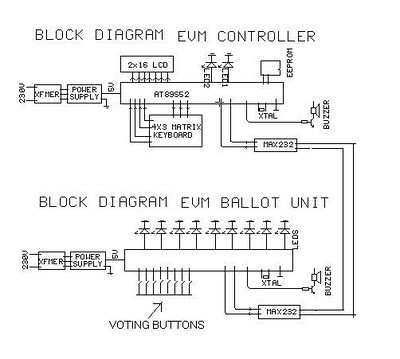
BLOCK DIAGRAM OF ELECTRONICS VOTING MACHINE WITH BALLOT UNIT

|
BLOCK DIAGRAM OF
ELECTRONICS VOTING MACHINE WITH BALLOT UNIT
Electronic Voting Maching Circuit ckt Diagram
Electronic Voting Maching Circuit ckt Diagram Project

Discription

2X16 LCD DISPLY USED
4X3 KEYBORD USED FOR PASSWORD ENTRY
WHEN CONTROLLER IS CONNECTED TO BALLOT UNIT AND WHEN BUTTON IS PRESSED ON BALLOT UNIT RESPECTIVE LRD GLOWS AND SERIALLY COMMUNICATED TO CONTROLLER TO UPGRADE THE DATA IN EEPROM AS WELL AS DISPLAYED ON LCD.
WHEN YOU WANT TO KNOW THE RESULT OF ELECTION CONNECT THE CONTROLER TO PC AND BY PRESSING THE KEY YOU CAN KNOW THE RESULT
ON MONITOR OF PC AS WELL AS SAVE THE FILE IN PC .
Click Here to Go Back To Complete list of Projects
Electronic voting Maching Project, Electronic Voting Maching Circuit, Electronic Voting Maching Free Project, Microcontroller based Electronic Voting Machine.

Cell Phone Operated land Rover ( landrover )

|

INTRODUCTION
Conventionally, wireless-controlled robots use RF circuits,which have the drawbacks of limited working range, limited frequency range and limited control. Use of a mobile phone for robotic control can overcome these limitations. It provides the advantages of robust control, working range as large as the coverage area of the service provider,no interference with other controllers and up to twelve controls.Although the appearance and capabilities of robots vary vastly, all robots share the features of a mechanical, movable structure under some form of control. The control of robot involves three distinct phases: reception, processing and action. Generally, the preceptors are sensors mounted on the robot, processing is done by the on-board microcontroller or processor, and the task (action) is performed using motors or with some other actuators.
PROJECT OVERVIEW
Cell phone operated land Rover
Cell phone operated land Rover,Robot,Moving Vehicle.circuit
In this project, the robot is controlled by a mobile phone that makes a call to the mobile phone attached to the robot. In the course of a call, if any button is pressed,a tone corresponding to the button pressed is heard at the other end of the call. This tone is called ‘dual-tone multiple-frequency’ (DTMF) tone. The robot perceives this DTMF tone with the help of the phone stacked in the robot. The received tone is processed by the ATmega16 microcontroller with the help of DTMF decoder MT8870. The decoder decodes the DTMF tone into its equivalent binary digit and this binary number is sent to the microcontroller.The microcontroller is preprogrammed to take a decision for any given input and outputs its decision to motor drivers in order to drive the motors for forward or backward motion or a turn. The mobile that makes a call to the mobile phone stacked in the robot acts as a remote. So this simple robotic project does not require the construction of receiver and transmitter units. DTMF signaling is used fr telephone signaling over the line in the voice-frequency band to the call switching centre. The version of DTMF used for telephone tone dialing is known as ‘Touch-Tone.’DTMF assigns a specific frequency (consisting of two separatetones) to each key so that it can easily be identified by the electronic circuit. The signal generated by the DTMF encoder is a direct algebraic summation, in real time, of the amplitudes of two sine (cosine)waves of different frequencies, i.e., pressing ‘5’ will send a tone made by adding 1336 Hz and 770 Hz to the other end of the line. The tones and assignments in a DTMF system are shown in Table I.
SCEMATIC OF CELLPHONE OPERATED LANDROVER
Cell phone operated land rover circuit,robot,moving vehicle
CIRCUIT DESCRIPTION
Fig. 1 shows the block diagram of the microcontroller-based mobile phoneoperated land rover. The important components of this rover are a DTMF decoder, microcontroller and motor driver. An MT8870 series DTMF decoder is used here. All types of the MT8870 series use digital counting techniques to detect and decode all the 16 DTMF tone pairs into a 4-bit code output. The built-in dial tone rejection circuit eliminates the need for pre-filtering. When the input signal given at pin 2 (IN-) in single-ended input configuration is recognised to be effective, the correct 4-bit decode signal of the DTMF tone is transferred to Q1 (pin 11) through Q4 (pin 14) outputs. Table II shows the DTMF data output table of MT8870. Q1 through Q4 outputs of the DTMF decoder (IC1) are connected to port pins PA0 through PA3 of ATmega16 microcontroller (IC2) after inversion by N1 through N4,respectively. The ATmega16 is a low-power, 8-bit, CMOS microcontroller based on the AVR enhanced RISC architecture. It provides the following features: 16 kB of in-system programmable Flash program memory with read-while-write capabilities, 512 bytes of EEPROM, 1kB SRAM, 32 general-purpose input/output (I/O) lines and 32 general-purpose working registers. All the 32 registers re directly connected to the arithmetic logic unit, allowing two independent registers to be accessed in one single instruction executed in one clock cycle. The resulting architecture is more code-efficient. Outputs from port pins PD0 through PD3 and PD7 of the microcontroller are fed to inputs IN1 through IN4 and enable pins (EN1 and EN2) of motor driver L293D, espectively, to drive two geared DC motors. Switch S1 is used for manual reset. The microcontroller output is not sufficient to drive the DC motors, so current drivers are required for motor rotation. The L293D is a quad, high-current, half-H driver designed to provide bidirectional drive currents of up to 600 mA at voltages from 4.5V to 36V. It makes it easier to drive the DC motors. The L293D consists of four drivers. Pin IN1 through IN4 and OUT1 through OUT4 are input and output pins, respectively, of driver 1 through driver 4. Drivers 1 and 2, and drivers 3 and 4 are enabled by enable pin 1 (EN1) and pin 9 (EN2), respectively. When enable input EN1 (pin 1) is high, drivers 1 and 2 are enabled and the outputs corresponding to their inputs are active. Similarly, enable input EN2 (pin 9) enables drivers 3 and 4. An actual-size, single-side PCB for cellphone-operated land rover is shown in Fig. 4 and its component layout in Fig. 5.
PCB LAYOUT FOR CELLPHONE OPERATED LANDROVER
Landrover pcb Design
pcb design free
SOFTWARE DESCRIPTION
The software is written in ‘C’ language and compiled using CodeVision AVR ‘C’ compiler. The source program is ed into hex code by the compiler. Burn this hex code into ATmega16 AVR microcontroller.The source program is well commented and easy to understand. First include the register name defined specifically for ATmega16 and also declare the variable. Set port A as the input and port D as the output. The program
will run forever by using ‘while’ loop. Under ‘while’ loop, read port A and test the received input using ‘switch’ statement. The corresponding data will output at port D after testing of the received data.
WORKING
In order to control the robot, you need to make a call to the cell phone attached to the robot (through head phone) from any phone, which sends DTMF tunes on pressing the numeric buttons. The cell phone in the robot is kept in ‘auto answer’ mode. (If the mobile does not have the auto answering facility, receive the call by ‘OK’ key on the rover-connected mobile and then made it in hands-free mode.) So after a ring, the cellphone accepts the call. Now you may press any button on your mobile to perform actions as listed in Table III. The DTMF tones thus produced are received by the cellphone in the robot. These tones are fed to the circuit by the headset of the
cellphone. The MT8870 decodes the received tone and sends the equivalent binary number to the microcontroller. According to the program in the microcontroller, the robot starts moving.When you press key ‘2’ (binary equivalent 00000010) on your mobile phone, the microcontroller outputs ‘10001001’ binary equivalent. Port pins PD0, PD3 and PD7 are high. The high output at PD7 of the microcontroller drives the motor driver (L293D). Port pins PD0 and PD3 drive motors M1 and M2 in forward direction (as per Table III). Similarly, motors M1 and M2 move for left turn, right turn, backward motion and stop condition as per Table III.
CONSTRUCTION
Cellphone operated land rover project
When constructing any robot, one major mechanical constraint is the number there a two-wheel drive or a four-wheel ive. Though four-wheel drive is more complex than two-wheel drive, it provides more torque and good control. Two-wheel drive, on the other hand, is very easy to construct. Top view of a four-wheel-driven land rover is shown in Fig. 3. The chassis used in this model is a 10×18cm2 sheet made up of parax. Motors are fixed to the bottom of this sheet and the circuit is affixed firmly on top of the sheet. A cellphone is also mounted on the sheet as shown in the picture. In the four-wheel drive system, the two motors on a side are controlled in parallel. So a single L293D driver IC can drive the rover. For this robot, beads affixed with glue act as support wheels.
PROGRAM FOR CELLPHONE OPERATED LANDROVER
Source program:
Robit.c
#include
void main(void)
{
unsigned int k, h;
DDRA=0×00;
DDRD=0XFF;
while (1)
{
k =~PINA;
h=k & 0x0F;
switch (h)
{
case 0×02: //if I/P is 0×02
{
PORTD=0×89;//O/P 0×89 ie Forward
break;
}
case 0×08: //if I/P is 0×08
{
PORTD=0×86; //O/P 0×86 ie Backward
break;
}
case 0×04:
{
PORTD=0×85; // Left turn
break;
case 0×06:
{
PORTD=0x8A; // Right turn
break;
}
case 0×05:
{
PORTD=0×00; // Stop
break;
}
}
}
}